
CRM for Tour Operators vs General CRMs: Why Travel-Specific Systems Perform Better at Scale
Article
Most tour operators don't outgrow their CRM because the software is bad. They outgrow it because it was never built for the realities of multi-day travel.
A generic CRM is designed around a universal sales workflow: track a lead, move it through a pipeline, close the deal. For most industries, that's enough. For tour operators running group and multi-day travel, a booking is where the rest of the work begins.
What General CRMs Do Well
General CRMs like Salesforce, HubSpot, and Zoho are powerful tools. They can be easily adopted, are well-supported, and effective at the core job of managing contacts and tracking sales activity.
You can compare generic CRMs to CRMs built for travel, including AI-powered travel CRMs, here.
Where General CRMs Break for Travel
In most industries, a closed deal is the end of the sales process. In travel, it's the beginning of the most complex part of the workflow.
A confirmed booking immediately creates a set of operational demands that general CRMs have no native concept of: collecting traveler information, managing a group manifest, tracking a multi-installment payment schedule, handling changes across weeks or months, and keeping everyone – sales, operations, finance, suppliers – working from the same record.
General CRMs weren't built for any of this. The result is a familiar pattern: the CRM tracks what happened in sales, while spreadsheets, inboxes, and separate payment tools track everything else. The more trips a business runs, the wider that gap becomes.
Three specific breakdowns stand out:
The deal model doesn't fit group travel. A generic CRM assumes one buyer, one deal, one outcome. Group travel regularly involves one booker managing multiple travelers, parents or coordinators paying on behalf of others, and shared payment responsibilities across a group. There's no clean way to represent this in a system built around a single-contact deal.
Payment status lives outside the CRM. Generic CRMs have no native payment awareness. Even with integrations, deposit status, outstanding balances, and overdue payments rarely reflect accurately inside the CRM, which means teams are constantly cross-referencing systems to answer basic questions about which bookings are at risk.
The record stops at conversion. The moment a lead becomes a booking, the CRM's usefulness stalls. Everything that follows – trip setup, traveler collection, payment tracking – happens in separate systems. Teams re-enter data that already exists, reconcile records that should never have been separated, and spend time on internal handoffs that a connected system would eliminate.

What a Travel-Specific CRM Handles Differently
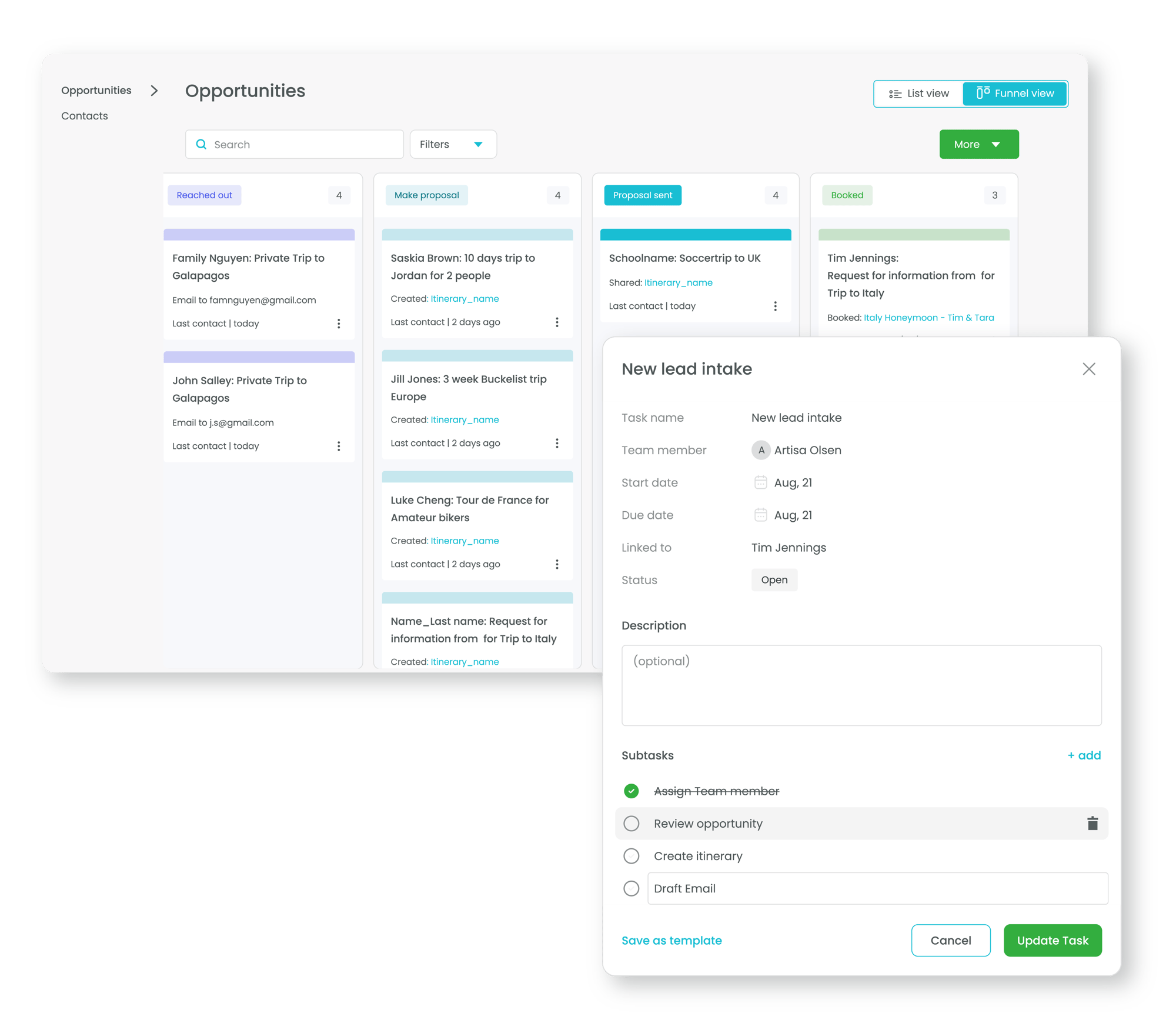
A travel CRM is structured differently. Rather than tracking deals, it tracks trips. Rather than contacts, it manages travelers. Rather than generic pipeline stages, it reflects the actual lifecycle of a booking – from first inquiry through final payment and trip delivery.
That structural difference is what determines whether a CRM stays useful after a booking is confirmed.
In a travel-specific CRM, inquiry forms feed directly into the pipeline without manual import. A confirmed booking doesn't require re-entry – the same record that captured the inquiry carries forward as it becomes a trip, with traveler profiles, payment schedules, and communication history linked automatically. Group manifests, multi-traveler bookings, and installment payment plans are native features, not workarounds.
Payment status updates the CRM in real time, so follow-ups are based on facts rather than assumptions. And because operations, finance, and sales all work from the same record, the internal handoffs that slow teams down at volume simply don't exist.
How WeTravel Approaches This
WeTravel is built around this connected model. Its travel CRM is not a separate sales layer – it lives inside the same platform as bookings, itineraries, payments, and traveler manifests.
When a new inquiry arrives, WeTravel captures it automatically – from brochure downloads, trip inquiry forms, contact forms, or waitlist signups – and creates a lead record linked to the relevant trip. From there, AI prompts follow-up and drafts a personalized reply informed by what that traveler did and what the system already knows about them.
When the booking is confirmed, nothing needs to be re-entered. The traveler profile, payment plan, and trip details are already there. As the trip progresses, payment status updates automatically, the manifest builds from traveler responses, and every team member works from the same current record.
This is what separates a travel CRM from a general one adapted for travel: not individual features, but the fact that the whole workflow – sales, operations, payments, traveler management – runs in one place from the start. If you already have a CRM but you’re looking for travel CRM integrations, it’s likely time to switch to a customer relationship management for travel.

What to Look for in a Travel CRM
For tour operators evaluating CRM options, the most important question isn't which platform has the most features. It's whether the CRM stays useful after a booking is confirmed.
A travel CRM should be able to answer:
-
Which inquiries arrived today, and have they been followed up?
-
Which bookings have outstanding payments, and who owns the follow-up?
-
What does the complete traveler profile look like – past trips, preferences, payment history?
-
Can a proposal be created and sent without leaving the CRM?
-
When a booking is confirmed, does the record automatically carry through to operations?
If the answer to any of those is "we handle that in a separate system," it may be time to look for a travel CRM.

The Bottom Line
For tour operators running multi-day and group travel, the limitations of a generic CRM become too important to work around with configurations or integrations.
A travel CRM handles the full lifecycle of a trip as a single connected workflow, rather than a sales process followed by a handoff to everything else.
Want to see how WeTravel's CRM handles the full trip journey? Request a demo.

FAQ
What is a CRM for the travel industry?
A CRM for the travel industry manages inquiries, bookings, travelers, and payments as one connected workflow, rather than treating sales as a standalone process that ends at conversion.
What is the difference between a general CRM and a travel CRM?
General CRMs track sales activity and contacts. A travel CRM tracks trips, travelers, and payments – staying connected through the full lifecycle of a booking, not just the sales stage.
Why do general CRMs fail for tour operators?
General CRMs are built around a single-contact deal model. Tour operators run group bookings with multiple travelers, multi-installment payment schedules, and operational workflows that begin at booking confirmation – none of which general CRMs handle natively.
What does a travel CRM need to handle?
A travel CRM needs to manage the full trip lifecycle: inquiry capture, lead follow-up, proposal creation, booking confirmation, traveler data collection, payment tracking, and group manifests – all in one connected system.
Does WeTravel CRM include bookings and payments?
Yes. WeTravel's CRM is built into the same platform as bookings, payments, and traveler manifests – so every record updates automatically as trips progress, with no manual reconciliation required.
Can WeTravel handle group and multi-day trips?
Yes. WeTravel is built specifically for group and multi-day travel, including multiple travelers per booking, group manifests, installment payment plans, and ongoing trip management.
How does WeTravel's AI work in the CRM?
When a new inquiry arrives, WeTravel's AI prompts follow-up and drafts a personalized reply informed by what that traveler did and what the system already knows about them – ready to review and send from your own email in one click.
Can WeTravel replace a general CRM for a tour operator?
For most tour operators running group and multi-day travel, yes. WeTravel replaces the combination of a standalone CRM and separate booking, payment, and operations tools — with one connected system that keeps everything in sync automatically.
What's the best CRM for multi-day tour operators?
The best CRM for multi-day tour operators is one built around trips rather than deals – where inquiries, bookings, travelers, and payments are connected in a single system from the start. WeTravel is built specifically for this workflow.
Is a travel-specific CRM worth it for smaller operators?
Yes. The structural limitations of general CRMs – disconnected payments, no group travel support, and records that break at conversion – affect operators at any volume. A travel-specific CRM removes those limitations from the start, rather than requiring workarounds as the business grows.
AI-Powered CRM for Tour Operators
Faster follow-ups. More bookings. Zero manual entry. Discover a CRM built for travel, powered by AI.
Follow us on social


