
AI-Powered CRM for Tour Operators: What It Does and Why It Matters for Bookings
Article
If you've found yourself wondering what "AI-powered" actually means for your travel business – beyond the feature announcements and the product updates – you're asking exactly the right question.
AI has moved quickly into travel software, and across a wide range of applications: itinerary building, content generation, client communications, and data management. The technology has already changed how operators work, helping businesses save time and grow.
There’s a new application that will become important for multi-day tour operators – and it lives inside the CRM.
This article explains what a travel CRM is, what AI does inside one, and what that means in practice for operators running group and multi-day trips.
What Is a Travel CRM?
In most industries, a CRM is a system for storing contact information, tracking sales conversations, and managing a pipeline of potential customers from first contact to closed deal.
For tour operators, a CRM needs to do more because the relationship with a potential booker is more complex than a standard sales process. A traveler might inquire about a trip weeks or months before they're ready to commit. They may have traveled with an operator before. They're often part of a group where one person is coordinating on behalf of others. And once they do book, the relationship continues through payment schedules, document collection, and trip preparation.
A travel CRM is built specifically around this lifecycle – connecting the first moment of interest to the full journey of a booking, and building a complete picture of each traveler across every interaction. Rather than tracking generic deals, it tracks trips. Rather than storing basic contact details, it accumulates traveler profiles over time — past trips, payment history, preferences, and conversations — so that every follow-up is informed by the full context of the relationship.
Where AI Fits In
Until recently, CRM tools for tour operators were essentially organized databases. They stored information and tracked status, but the work of following up, drafting replies, and staying on top of new inquiries still fell entirely to the operator.
AI changes one specific and important part of that workflow: the moment a new inquiry arrives.
In a multi-day travel business, that moment is time-sensitive. A traveler researching a trip is typically comparing several operators at once. The first response that arrives – provided it's relevant and personal – frequently shapes which operator they continue the conversation with. An inquiry that sits unanswered, or receives a generic acknowledgment while a thoughtful reply is being drafted, is a booking that may already be moving elsewhere.
The challenge for most operators isn't awareness of this – it's capacity. There are only so many hours in the day, and inquiries don't arrive on schedule.

What WeTravel's AI Does in Practice
WeTravel built an AI-powered CRM around this specific challenge. You can compare it to other CRMs here.
AI acts the moment a new inquiry arrives, before the operator has to open their inbox. Here's what that looks like in practice:
Step 1 – The inquiry is captured automatically
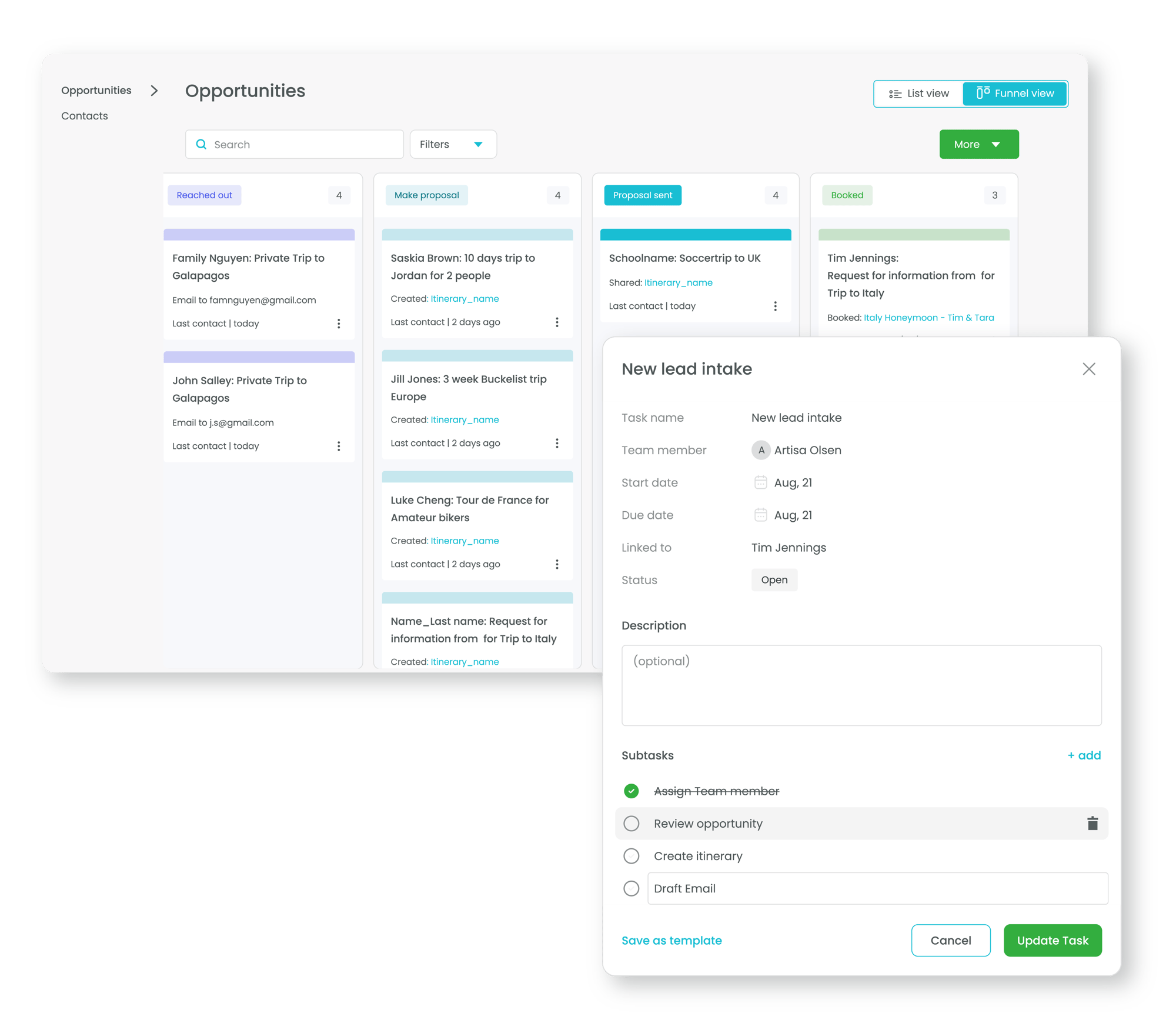
Every new inquiry creates a lead record, linked to the specific trip the traveler expressed interest in and the action they took — whether that's a trip inquiry form, a brochure download, an itinerary question, or a waitlist signup. No manual import, no inbox checking required.
Step 2 – AI reads the full context
The system looks at everything it knows about that traveler – the trip they’re interested in, the action they took, their booking history – and combines that with the details of the inquiry itself.
Step 3 – A personalized reply is drafted
AI drafts a reply informed by the specific traveler and the specific trip – not a template, but a contextually relevant message that reflects what the system knows about this person and what they asked about.
Step 4 – The operator is prompted to follow up
The notification arrives with the draft already written. The operator reviews it, edits if they choose to, and sends it from their own Gmail or Outlook in one click.
The key distinction: The judgment, the relationship, and the final word remain entirely with the operator - WeTravel's AI doesn't send anything without the operator's review. What it does is remove the gap between the inquiry arriving and a thoughtful, personal reply being ready to send.

Why Travel-Specific AI Matters
The reason this works, and the reason general-purpose AI tools don't replicate it cleanly, comes down to what the AI is connected to.
What makes a follow-up feel genuinely personal in a travel context is information that only exists inside a travel-specific system: which trip did this traveler inquire about, have they traveled with this operator before, what's their booking history, and what specific action triggered this inquiry?
For operators using a general CRM connected to a separate booking platform, that context can sometimes be bridged through integrations – syncing data between systems so that each has visibility into what the other holds. Integrations have their place, and many operators use them effectively. But they add a layer of setup, maintenance, and occasional lag between systems that a native connection doesn't require.
When AI is built into the same platform as the trip data, booking history, and traveler profiles, it has access to all of that context automatically – and there's nothing to sync.
WeTravel's AI is connected to the full traveler record from the start, because the CRM, booking history, payment data, and trip details all live in the same system.
The personalization the AI produces is drawn from the complete picture of the traveler's relationship with the operator, in real time, without any additional configuration.
What AI in a Travel CRM Doesn't Do
WeTravel's AI handles one specific and valuable part of the workflow: the moment between a new inquiry arriving and the operator being ready to respond. It doesn't design itineraries, negotiate with suppliers, or make decisions about how a trip is priced or positioned. It doesn't replace the expertise, judgment, and relationship-building that define a great multi-day travel business.
What it does is remove the friction from the part of the workflow that doesn't require the operator's expertise – but currently requires their time – so that the parts that do require them receive more attention.

The Practical Effect on Bookings
Two outcomes emerge for operators using AI-powered follow-up in their CRM.
The first is improved conversion rate. Travelers making multi-day trip inquiries are almost always contacting more than one operator at the same time. The first response – provided it's relevant and personal – frequently shapes which operator they continue the conversation with. The longer the gap between inquiry and first reply, the more likely the conversation has already moved elsewhere.
The second is increased capacity. For a small team handling growing inquiry volume, or an operator whose inquiries arrive across time zones, AI follow-up means the business responds with consistency and speed regardless of when an inquiry comes in. The inquiry that arrives on a Sunday evening receives the same quality of first response as one that arrives on a Tuesday morning.
AI as Infrastructure, Not a Feature
The most useful way to think about AI in a travel CRM is not as a feature you activate or a button you click – but as infrastructure that runs as part of the system, handling the time-sensitive work of inquiry response in the background while the operator focuses on everything else.
For operators who have felt the gap between the volume of inquiries coming in and the capacity to respond to all of them well, this is the application of AI that closes it, in a way that keeps the operator in control.
Curious to see how it works in practice? Book a discovery call, and our team will be happy to walk you through it.
FAQ
What is a travel CRM?
A travel CRM is a customer relationship management system built specifically for travel businesses. Unlike generic CRMs that track contacts and deals, a travel CRM manages the full lifecycle of a traveler relationship — from first inquiry through booking, payment, and trip delivery — in one connected system.
What is an AI-powered CRM for tour operators?
An AI-powered CRM for tour operators is a travel CRM that uses AI to automate and personalize the inquiry follow-up process. When a new inquiry arrives, the AI drafts a personalized reply informed by the traveler's history and the specific trip they expressed interest in — ready for the operator to review and send.
How does AI in WeTravel's CRM work?
When a new inquiry arrives, WeTravel's AI reads the full context — which trip the traveler is interested in, their history with the operator, and the specific action they took — and drafts a personalized reply automatically. The operator reviews it and sends from their own email in one click.
Does WeTravel's AI send replies automatically?
No. WeTravel's AI drafts the reply and prompts the operator to follow up — but the operator reviews and sends it. The judgment and the final word remain entirely with the operator.
What's the difference between AI in a generic CRM and AI in a travel CRM?
Generic CRM AI drafts email copy based on basic contact data. Travel CRM AI is connected to trip history, booking data, payment records, and inquiry context — making the drafts it produces specific to the traveler and the trip, rather than generalized templates.
Does WeTravel's AI replace the operator?
No. WeTravel's AI handles the operational layer between inquiry arrival and a draft reply being ready — removing the time and friction from that step. The creative, experiential, and relationship-driven parts of the business remain entirely human.
What is the best AI CRM for tour operators?
The best AI CRM for tour operators is one where AI is built natively into the travel workflow — connected to trip data, booking history, and traveler profiles — and acts at the moment an inquiry arrives to draft a personalized reply informed by the full traveler context.
How does AI improve inquiry response time for tour operators?
WeTravel's AI drafts a personalized reply the moment an inquiry arrives, before the operator has opened a notification. This reduces the gap between inquiry arrival and a reply being ready to send to minutes, regardless of when the inquiry comes in.
Can a small travel business benefit from an AI CRM?
Yes — particularly so. Solo operators and small teams handling growing inquiry volume benefit most, because AI follow-up allows the business to respond quickly and personally without the capacity constraints of a small team.
Is WeTravel's AI CRM available on all plans?
WeTravel's CRM, including AI-powered follow-up, is available on the Pro plan at $79/month — with no per-seat fees and unlimited team members.
AI-Powered CRM for Tour Operators
Faster follow-ups. More bookings. Zero manual entry. Discover a CRM built for travel, powered by AI.
Follow us on social


